
How can a team building facilitator help high-pressure teams work better together?
- Surfacing unspoken dynamics
- Improving communication norms
- Aligning on shared goals
- Building psychological safety
- Developing resilience
Overview
- High-pressure teams need more than traditional team-building activities to improve collaboration.
- A skilled team-building facilitator helps teams manage stress, uncover hidden dynamics, establish healthier communication norms, align on shared goals, and develop resilience through science-backed experiences.
In high-pressure environments, even the most talented professionals can slip into survival mode. They are becoming reactive, defensive, or completely disconnected from one another.
When stress takes the driver’s seat, collaboration is usually the first thing to get thrown out the window. This raises a critical question for leadership: How can a team-building facilitator help high-pressure teams work better together?
The answer has very little to do with cheesy icebreakers or temporary entertainment. Instead, it is about deep behavioral alignment and psychological safety. A skilled facilitator uses science-backed communication tools and Neuro-Linguistic Programming (NLP) to help teams regulate stress, communicate effectively, and thrive under pressure.
Surfacing Unspoken Dynamics
High-pressure teams don’t always struggle because of a lack of skill. More often than not, performance suffers because people carry unspoken frustrations, unanswered questions, or concerns they don’t feel comfortable raising. Keeping these thoughts buried requires constant mental effort.
A skilled team-building facilitator creates the conditions for honest conversations by establishing emotional safety from the very beginning. They set clear expectations, pace activities thoughtfully, model openness, and use inclusive facilitation techniques that encourage every team member to participate with confidence.
For example, after a collaborative exercise, they may ask what made teamwork feel effective or challenging, using those insights to uncover underlying dynamics that influence how the team works every day. By bringing these issues into the open, teams reduce the mental effort spent suppressing concerns and can redirect their energy toward clearer thinking and stronger collaboration.
Improving Communication Norms
People interrupt, make assumptions, or respond defensively because their brains are focused on protecting themselves rather than understanding others. These instinctive reactions can quickly escalate misunderstandings.
A skilled team-building facilitator helps teams replace assumptions with shared communication practices. They help teams establish clear communication norms for urgency, communication channels, responsibilities, and decision-making.
Instead of prescribing solutions, facilitators encourage teams to define these norms together through guided discussions. Questions like, “When should we use chat, email, or a meeting?” or “What information should always be included in an urgent request?” prompt teams to reflect on their current habits and identify opportunities for improvement.
Aligning on Shared Goals
Ambiguity is a massive driver of workplace anxiety. Without absolute clarity on priorities and roles, people begin operating on assumptions. For a burned-out executive, this means constantly stepping in to fix duplicated efforts and conflicting decisions. For a young professional, it creates paralyzing stress about whether they are actually doing a good job.
A skilled team-building facilitator clears this fog by turning abstract company objectives into a shared, co-created roadmap.
Instead of lecturing from a whiteboard, they use interactive exercises that encourage the team to define priorities and clarify boundaries together. This shift from “being told what to do” to “actively building the plan” changes everything. With a unified direction in place, the daily friction melts away.
Building Psychological Safety

When team members are constantly worried about being judged, blamed, or dismissed, their brains naturally shift into survival mode. Speaking up with a bold idea, asking a clarifying question, or admitting to a mistake feels like a massive career risk. Under high pressure, this silence is toxic.
Building psychological safety is about creating an environment where your team feels secure enough to be radically candid and innovate without fear of backlash.
That’s why at Trainstation, we don’t just tell teams to “trust each other” and hope for the best. We intentionally dismantle these subconscious social barriers using our signature EnterTRAINment approach and science-backed Neuro-Linguistic Programming (NLP) methodologies. We design low-stakes interactive challenges where raw participation is celebrated, and vulnerability is met with respect rather than judgment.
Developing Resilience
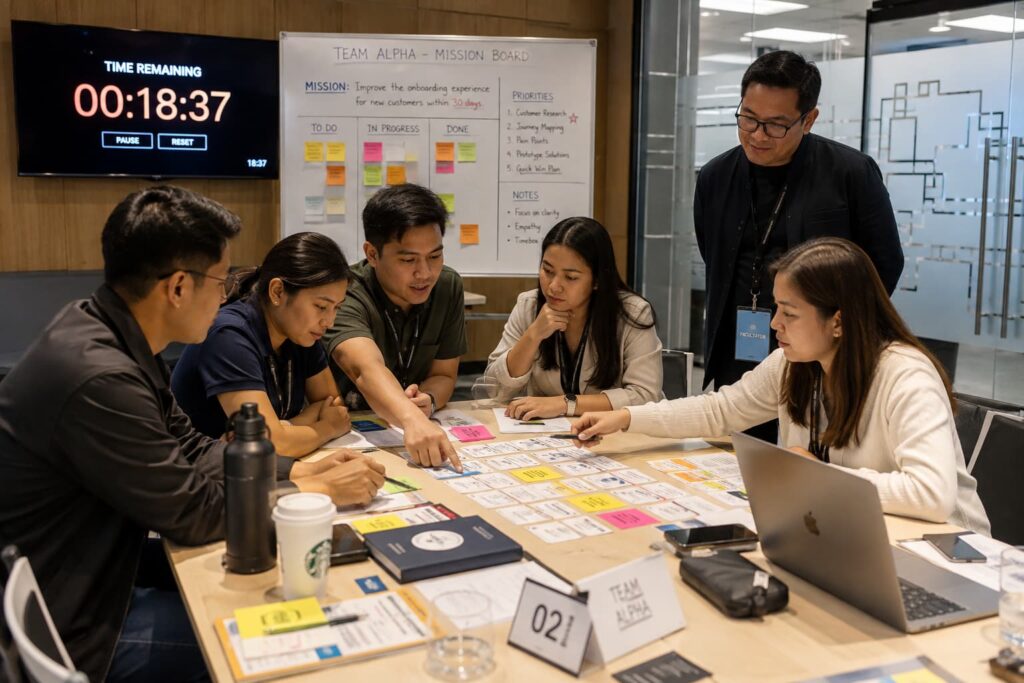
High-pressure teams become resilient when they learn to stop simply reacting to crises and start navigating them as a unified front. Each successful challenge strengthens the team’s stress response, confidence, and ability to adapt.
At Trainstation, we know that team resilience is a collective muscle built through shared experiences. Through our experiential learning activities, we simulate realistic workplace pressures. Your team is thrown into fast-paced, challenging scenarios that require rapid collaboration, strategic problem-solving, and decisive action under stress.
The magic doesn’t just happen during the activity; it happens during the guided reflection afterward. We help your team dissect their performance: What kept us calm? When did panic set in? How did we adapt?
Key Takeaway
The real magic of how a team-building facilitator helps high-pressure teams work better together lies in their ability to design experiences that actually rewire how people respond to stress.
At Trainstation, we don’t just host events; we facilitate breakthroughs. Through our NLP-grounded experiential learning programs, we help your people dissolve internal friction and build a culture of psychological safety.
Ready to transform your team’s pressure into peak performance? Connect with our team today, and let’s design a customized program for you.